View this post on Instagram
A post shared by Dr. Julie Sarton & The Pelvic Healing Team (@pelvichealing)
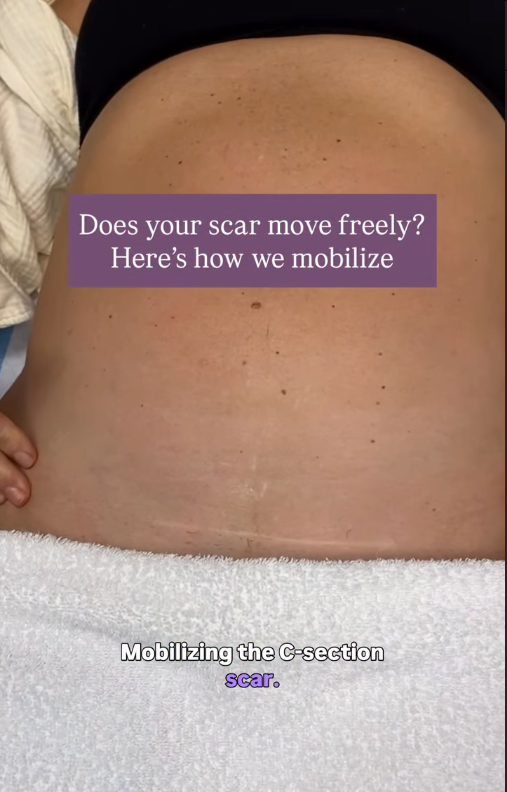
Why Does C-Section Scar Mobility Matter?
A C-section affects more than the skin you can see at the surface.
During healing, scar tissue develops as part of the body’s normal repair process. The skin, fascia, and underlying tissues need to move in relation to one another.
When mobility becomes restricted, you may notice that certain areas around the scar feel:
- Tight
- Firm
- Lumpy or bumpy
- Sensitive
- Difficult to lift or move
- Different from one side of the scar to the other
Importantly, the restriction isn’t always limited to the scar itself.
The fascia throughout the abdomen is interconnected, so restrictions elsewhere in the abdominal wall may influence the sensation of pulling or tension around the C-section scar.
That’s why treatment may begin by assessing the surrounding abdomen rather than immediately working directly on the incision.
When Can You Start C-Section Scar Mobilization?
Scar mobilization should not be performed over a C-section incision that hasn’t fully healed.
Before beginning direct scar work, the incision should be closed and healed without signs of infection, opening, drainage, or other complications. Your healthcare provider or postpartum physical therapist can help determine when direct scar mobilization is appropriate.
Once the area is ready, treatment can gradually progress based on how the tissue responds.
How Is a C-Section Scar Mobilized?
There isn’t one single scar-mobilization technique. A physical therapist may use several approaches depending on where restrictions are found.
1. Mobilizing the Surrounding Abdominal Fascia
Treatment may begin above and around the C-section scar.
Rather than focusing exclusively on the incision, a therapist can assess how freely the skin and fascia throughout the abdomen move.
Gentle fascial mobilization may be used to address areas that feel restricted and reduce tension surrounding the scar.
2. Circular Mobilization Around the Scar
Once the scar has fully healed, gentle circular movements can be performed above and below it.
The goal isn’t to aggressively push into the tissue. Instead, gentle tension is applied to the skin while exploring how easily the tissues move in different directions.
This can also help identify areas that feel different from the surrounding tissue.
3. Cross-Friction Mobilization
Another technique involves moving gently across the scar rather than only following its length.
This cross-friction movement can help assess and address restrictions in the tissue surrounding the incision.
Some portions of the scar may move easily, while another section may feel firmer or more restricted.
Why Can One Side of a C-Section Scar Feel Different?
It’s common for a scar not to feel identical from one end to the other.
One area may feel smoother and more mobile, while another may feel thicker, tighter, or more irregular.
Rather than assuming that every part of the scar needs the same treatment, a physical therapist can assess these differences and focus treatment on areas where mobility is actually restricted.
Skin Rolling Over a C-Section Scar
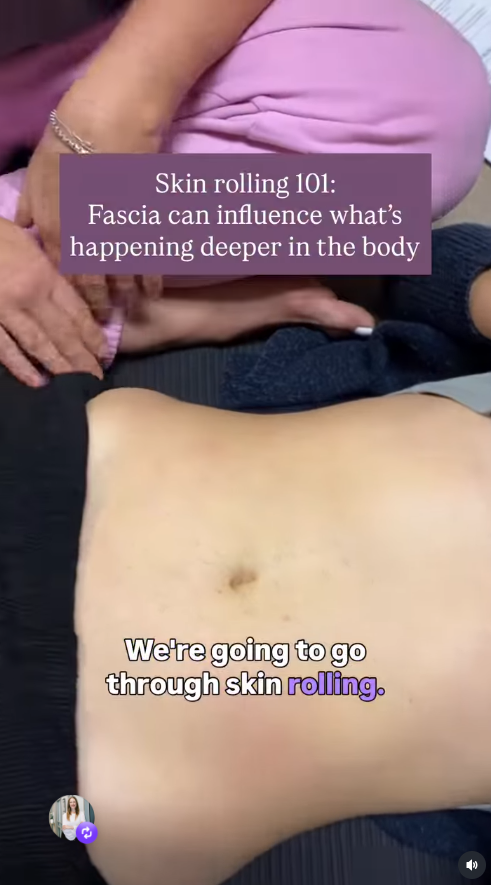
Once sufficient healing has occurred and the tissue can comfortably tolerate it, skin rolling may also be used.
During skin rolling, the skin and superficial connective tissue are gently lifted and moved between the fingers.
If the scar and surrounding tissues move freely, it may be possible to gently lift the tissue and work along the incision.
However, some scars can feel significantly restricted or “stuck down,” making the tissue difficult to lift.
In those situations, a therapist may use other techniques instead of forcing the tissue.
What If the Scar Feels Stuck?
A C-section scar that feels difficult to lift may require a more gradual approach.
A physical therapist may use gentle fascial pulling or other manual therapy techniques to work with the surrounding tissue first.
In some cases, clinicians may also consider tools or techniques such as therapeutic cupping when appropriate.
The important principle is that scar mobilization should be progressive and individualized. More pressure isn’t automatically better.
C-Section Scar Treatment Should Look Beyond the Scar
One of the most important parts of C-section scar rehabilitation is recognizing that the visible scar is only one part of the picture.
A postpartum physical therapist may evaluate the scar along with:
- Abdominal wall mobility
- Fascial restrictions
- Core function
- Breathing mechanics
- Pelvic floor function
- Hip and trunk mobility
- Pain or sensitivity around the abdomen
This broader approach can help determine whether the scar itself is restricted or whether other tissues are contributing to the pulling or tension you’re experiencing.
The Bottom Line
A healed C-section scar should be evaluated as part of the larger abdominal and pelvic system.
Gentle techniques such as fascial mobilization, circular movements, cross-friction work, and skin rolling may be used to improve tissue mobility when appropriate.
But timing matters. Direct scar mobilization should only begin once the incision has fully healed and you’re medically cleared to work on the area.
If your C-section scar feels painful, sensitive, tight, difficult to move, or “stuck,” a postpartum physical therapy evaluation can help determine what tissues are restricted and which techniques are appropriate for your recovery.