View this post on Instagram
A post shared by Dr. Julie Sarton & The Pelvic Healing Team (@pelvichealing)
Where Does the Pudendal Nerve Come From?
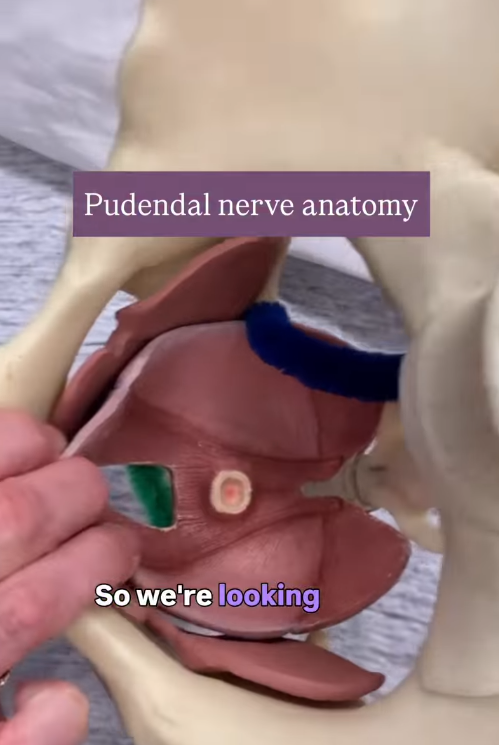
The pudendal nerve originates from the sacral nerve roots S2, S3, and S4.
From these nerve roots, it travels through the pelvis and follows a pathway around several important muscles, ligaments, and bony structures.
One particularly important landmark is the ischial spine.
The pudendal nerve passes near the ischial spine before continuing through the pelvis. Because this area contains multiple structures packed into a relatively small space, restrictions or irritation along the nerve’s pathway may contribute to symptoms associated with pudendal neuralgia.
The Pudendal Nerve and Alcock’s Canal
After passing around the ischial spine, the pudendal nerve enters a passageway called Alcock’s canal, also known as the pudendal canal.
This canal runs along the obturator internus fascia and provides a pathway for the pudendal nerve and accompanying blood vessels.
The anatomy here matters because the health of a nerve isn’t determined only by the nerve itself. The mobility and condition of the muscles, fascia, ligaments, and other connective tissues surrounding the nerve can also influence how freely it moves.
That’s one reason a comprehensive pelvic floor physical therapy evaluation may examine much more than the location where someone actually feels pain.
What Are the Three Branches of the Pudendal Nerve?
As the pudendal nerve continues through the pelvis, it ultimately divides into three primary terminal branches:
- Dorsal nerve of the clitoris or penis
- Perineal nerve
- Inferior rectal nerve
These branches provide sensory and motor functions to different areas of the pelvis and perineum.
Because of this distribution, irritation involving the pudendal nerve can potentially produce symptoms in different locations rather than one single predictable spot.
Why Can Sitting Irritate the Pudendal Nerve?
The pathway of the pudendal nerve helps explain why sitting can be particularly uncomfortable for some people with pudendal nerve irritation.
As the nerve travels through the pelvis, portions of its course run close to the ischial spine and ischial tuberosity—bony landmarks associated with the region that bears pressure while sitting.
For someone with an already sensitive or irritated pudendal nerve, sustained pressure in this area may aggravate symptoms.
However, pain with sitting does not automatically mean someone has pudendal neuralgia. Pelvic pain can have many potential causes, which is why a thorough evaluation is important.
Why We Look Beyond the Nerve
When treating pudendal nerve-related symptoms, focusing exclusively on the nerve may miss part of the picture.
The nerve travels through a complex environment containing muscles, fascia, ligaments, and other connective tissues.
That includes structures around the ischiorectal fossa as well as superficial pelvic floor muscles such as the:
- Transverse perineal muscles
- Ischiocavernosus
- Bulbospongiosus
If these tissues have excessive tension, mobility restrictions, or other dysfunction, they may need to be considered as part of a broader treatment plan.
Treating Pudendal Nerve Symptoms Requires a Whole-Pelvis Approach
Pudendal nerve anatomy demonstrates why pelvic floor treatment often involves more than treating the exact location where someone experiences pain.
A pelvic floor physical therapist may evaluate the nerve’s pathway, surrounding connective tissue, pelvic floor muscle function, hips, posture, movement patterns, and other factors that could be contributing to symptoms.
The goal is to understand why the nerve may be irritated rather than simply chasing the painful area.
If you’re experiencing persistent pelvic or perineal pain, burning, numbness, sensitivity, or symptoms that worsen while sitting, a comprehensive evaluation can help determine what structures may be contributing to your symptoms and what treatment approach makes sense for you.